An institution is an institution because as a collective we identify it as such.
The institution of money may be the best demonstration of this concept. But religion is a pretty good one too.
A religious example I particularly enjoy using is the Roman “Catholic” Church. I was a Roman seminarian for two years. Maybe that was a big deal, but intrinsically it’s like anything else. The Roman Church is said to have intrinsic value when it doesn’t. Like money, it’s only worth something if collectively we say it is.
In the end, I became disillusioned like Dorothy before the smoke and mirrors of Oz. Rome is merely another institution. Its value solely depends on what millions think about it, rather than what it really is (if in reality it exists at all).
In other words, when we collectively perceive that a $100 bill is no longer worth $100, it’s no longer worth $100. Likewise, when it’s no longer perceived by millions that the Roman Church is the church established by the incarnate God, or the second person of the “one”, triune God, then it no longer holds that distinction.
That distinction only exists in the collective imagination of humans throughout human history.
And that’s it.
Papal Exhibit A
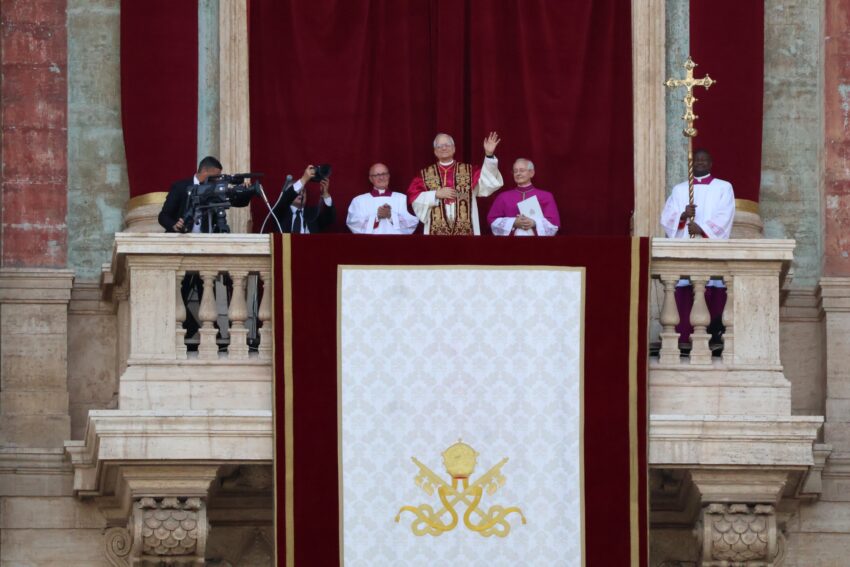
“Habemus papam!” we’re told.
Personally speaking, I’m sure he’s a really nice guy. But his title alone says he’s merely the next wizard (pope) of Oz (Rome). I don’t doubt that he spends a lot of time in prayer and thinks deeply about the most important questions we have as humans.
From what I read, he lived an austere life in Peru far from the luxuries most Americans experience today, even Americans of modest means. And he would know what he lost because he’s an American himself.
But he’s only the “vicar of Christ” because he’s perceived as such by millions.
The Roman emperor, supposedly, was divine. He doesn’t seem so divine now because collectively humans no longer assign him that value. That’s not to say humans collectively perceive the pope as divine. But maybe after a few more centuries (if we humans haven’t destroyed each other yet with advanced technology) millions won’t collectively imagine him as the new “supreme pontiff”.
Millions say so, so it must be true
Let’s explore the history of how this new pope has been collectively perceived throughout his life. This will demonstrate what determines his worth as a holy being. Does the third person of the “one”, triune God, AKA the Holy Spirit, determine his value, or is his value determined by the perception of the collective imagination of millions?
Let’s examine this history of perception of Pope Leo XIV, born and raised Robert Francis Prevost:
A layman
He’s a Chicago kid named Bob, reportedly nicknamed “Holy”. Others collectively perceive him to hold two indelible marks upon his soul (or sacramental characters), baptism and confirmation
An Augustinian novice
Others don’t collectively perceive him to hold any new indelible marks yet, but he has advanced in holiness, surpassing the ordinary layman. Newly-worn vestments (more specifically, a garment known as a habit) prompts this collective perception of advanced status.
The Augustinian order reinforces this collective perception of Bob as it is perceived to be guided by the Holy Spirit, perceived as the third person of the “one”, triune God.
The collective perception isolates Bob pyschologically from everyday society as he is now a member of a clerical subculture. Roman adherents are now to address him as “Brother”.
A deacon
Others now perceive him as the owner of a new indelible mark blotched upon his soul — holy orders. This perception has others to believe he has been promoted, institutionally, in holiness.
His habit is black.
Since the minds within the Roman world perceive a prior or provincial to be the head of this Augustinian institution (with the institution also as a mere perception existing solely in the minds of the collective), Deacon Bob and others must remain submissive to the man they imagined this Holy Spirit had sent.
Although it’s likely, modest as he may seem, he wouldn’t mind being on a first-name basis with members of society at-large, it would still be nice to call him “Deacon Bob”. In formal situations, Roman adherents may call him the Rev. Mr. Robert Francis Prevost
A priest
Rome now mandates all to call Bob “Father” publicly and privately. This reference is not a requirement within a private context, however, for bishops, priors, and fellow priests. But it would be ill-advised, even for a bishop, to address or to speak about Father Bob publicly without referencing him as “Father”.
Formally now, he is “Rev. Fr. Robert Francis Prevost”. No longer does he have to submit himself to priests. Instead, he is free to carry a private conversation with them on a first-name basis.
Still, despite his advancement of rank in holiness declared by an institution, he remains submissive to his religious superiors; the mere mortal whom the third person of the triune God assigned to control him, or “configure him to the person of Jesus Christ”
A bishop
This is a huge advancement in institutional, or declared, holiness for our subject. His new clothes reinforce this perception of Roman adherents. Something clicks in their minds. Here they have a successor to the apostles through the “laying on of hands”.
What are the objects that signal this kinship to the twelve? They would be the amarnath-red zucchetto and sash and a pectoral cross (that’s some really nice bling).
Out of respect, Roman adherents are to address him as “Your Excellency”. In Europe, it would be “My Lord”.
Former peers, mere priests, deacons, friars, etc., must submit to him (or at least publicly grovel before his presence under the watchful eyes of the faithful when they’re not alone having a drink.)
Bishops, however, may find it difficult to appear modest yet demand and maintain the respect that their episcopal office (a theoretical concept instead of a physical reality) requires.
A cardinal
He may not be adding another indelible mark to his soul, but another new set of colors makes him exceptional before the world. In the minds of many, he’s a prince!
And now he’s to be addressed as “Your Eminence”.
He’s exchanging the amaranth red for the cardinal red. Expect to see him traveling frequently to the Vatican City State where cardinal birdwatchers will hound him for photos.
His new status also guarantees him a vote in the next papal conclave unless he’s 80-years-old by that time. A past successor of Peter (a concept perceived to be “true”) had determined that the Holy Spirit cannot penetrate the mind of a senile old man to vote correctly.
(But if the Holy Spirit is involved, wouldn’t all votes fall the same? If not, then how often is the Holy Spirit contradicting itself?)
The pope
Robert Francis Cardinal Prevost humbly accepts the post as the perceived leader of Christendom. The new white vestments tell the world that he is who millions, or billions, collectively say he is: the “Vicar of Christ”, the “successor to Peter” as the “first bishop of Rome”, the “Supreme Pontiff” or Pontifex Maximus, leader of the empire’s replacement religion.
The deception that underlies this all
This deception I speak of isn’t only in reference to religion, or Catholicism, or Christianity. They’re merely a small portion of the general deception that rules us all. Deception is the undercurrent of most of the things we experience, such as advertising, the news, politics, and even education.
We have institutions. Supposedly, they are real because physical infrastructure is the outgrowth from these institutions . But the engine behind the physical, man-made realities we see is what lies in our collective conscious. Once the multitude holds an idea in common, it becomes an institution.
The church is merely one of these things. We have a tiny group of people from the population who’ve inherited a message that has convinced billions over time that this institution, the church, is real. We think it’s real, so we’re motivated to create things that are an outgrowth of what is in our collective consciousness, such as cathedrals, abbeys, vestments, liturgies, titles, offices, etc.
The same can be said for anything else that isn’t categorized as religion.
Whose revelation?
One may argue, “No, the primacy of Peter as exemplified by the Church of Rome is divinely revealed” the same way the Bible is “divinely revealed”, and so forth.
If this is all divinely revealed, then it’s up to the believer to demonstrate that this is revealed by God instead of men of history who said this was revealed by God.
Until then, the papacy is one example of many institutions, religious or secular, that is only worth what people say it’s worth. This same rule also applies to the perceived, rather than intrinsic, value of a $100 bill.