
THE CLAIM: Everything contained within the Bible is God’s word.1
There are many discussions surrounding this claim. I may take up more in future posts.
Here, however, I argue that belief in God’s existence should not be contingent upon the belief that the Bible is God’s word. In other words, were one to deny the claim presented above, and that denial drew the accusation of atheism, it would follow that the accusation remains unsubstantiated. One cannot conclude that denying the Bible to be God’s word is to deny ipso facto God’s existence.
My discussion here mainly involves westerners who are or who have been associated with Christianity in some way. They’re generally expected to accept the above claim as true. This expectation, of course, isn’t as high for those rooted in other religions, especially Judaism and Islam. It’s no surprise to anyone that these others would deny the Christian Bible as divinely inspired or inerrant. But Christians, for the most part, understand these others to be theists, not atheists, even though their view of God’s nature drastically varies.
Former Christians likely find the Bible unconvincing, but it’s important to keep in mind that a denial of its divine inspiration or inerrancy is not necessarily a denial of God’s existence.
A similar accusation from the trial of Socrates
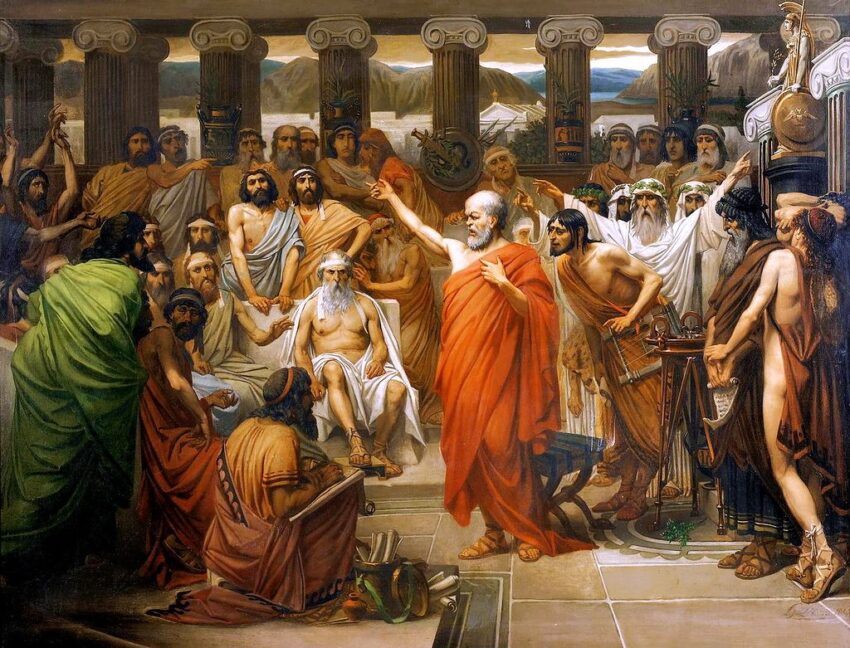
To label as atheists the naysayers of the claim above brings to mind one of two charges the Athenian citizen Meletus made against Socrates (470-399 BC), ultimately leading to the philosopher’s demise. As one charge concerned corrupting the minds of the Athenian youth, the other, atheism, is more to my point here.
During the trial, as recounted by Plato in his work The Apology,2 Socrates asked Meletus, his accuser, to clarify his charge of atheism. He wanted to know if this charge involved his admitted unwillingness to recognize the official Athenian gods, or if it simply involved an alleged denial of the existence of any god.
Meletus clarified the charge, calling Socrates a “complete atheist.”
As ludicrous as Meletus’ response was (at least in Plato’s mind), Socrates responded by demonstrating how Meletus contradicted himself with this charge after he had sworn in the affidavit that the philosopher believed in divine or spiritual agencies; i.e., lower divinities more commonly believed to have existed in the ancient world.
“…and yet if I believe in divine beings, how can I help believing in spirits or demigods; — must I not?”3
Bible-believing4 Meletianism
I find a parallel here. Occasionally a Bible Christian accuses someone of atheism when he denies the above Christian claim. If the accused expresses a belief in God, then there still remains no certainty that he contradicts himself.
As when Socrates denied atheism, Meletus could not accuse him of lying since Socrates acknowledged other divine beings not endorsed by the state. What if Socrates’ god or gods existed? What if they didn’t? Either way, Meletus had no knowledge which was true. Still, he continued to accuse Socrates with confidence and ignorance.
Today, one accused of atheism likely won’t believe in another god or gods. And the accusers very likely wouldn’t agree that the Christian Bible is God himself even though they may presume one cannot exist without the other.
However, there is a parallel here. This accusation is lightly tossed about when someone doesn’t wholeheartedly accept as true something many Christians take for granted. As Meletus took for granted that the Athenian gods were the true gods, many Bible Christians today take for granted their preconceived notion as to what the Bible is. It’s “God’s word” just like the grass is green. Nothing to think about here.
Were a member of, say, the Southern Baptist Convention to deny divine inspiration or biblical inerrancy, his fellow members may rightfully accuse him of heresy against the convention’s Statement of Faith, but their accusation of atheism rings hollow still.
Just like Meletus does not know that the Athenian gods are the true gods, Bible Christians do not know that the Bible is “God’s word.” To deny the Athenian gods is atheism just as to deny divine revelation is atheism.
This becomes a case where not accepting the other’s form of religion draws accusations of atheism. To protest and say, “But I do believe in God’s existence,” is a futile exercise.
Denying divine revelation while simultaneously acknowledging God’s existence isn’t as shocking as would be the claim above. That’s because it’s virtually impossible to defend the claim. The claim can only be considered if the claimants demonstrate each clause within the canon of scripture — what we today define as the Bible — is the “word of God.” If they can do that, then their accusation of atheism becomes much more considerable at the least.
To clarify a statement as belief or knowledge
Others may disagree here, but I find it pointless to persuade someone else of any beliefs that I may have. I have no problem attempting to persuade by way of premises based on shared knowledge or knowledge of something I can demonstrate to be true. If belief, however, or lack of knowledge is the basis of at least one of my premises, then my whole argument is pointless.
It’s one thing to persuade a belief to be true, but it’s quite another to have the listener believe there’s knowledge to be had when in reality there’s not. Rather, the speaker must disclose that he’s expressing belief rather than knowledge.
In other words, one making the above claim ought to note that belief, rather than knowledge, is its basis.
- This blog entry discusses mainly the views of Bible Christians, or biblical fundamentalists of some sort. Here I will make exclusive reference to the Protestant canon of scripture with its 66 books. There are other Christian canons such as that of the western church (Roman Catholicism) and of the eastern church (Orthodoxy) each with scriptures in their Old Testament not contained in the Protestant canon. ↩︎
- Plato (2015). Complete Works of Plato (e-reader version). Titan Read Classics. ↩︎
- Ibid. ↩︎
- To clarify, when I write “Bible believer,” “Bible Christian,” etc., I’m referring to those who make the claim outlined at the top of this entry. ↩︎