We draw sharp dividing lines in our minds that differentiate one religion from another. It’s easy to do so. We have generally agreed for centuries that, for example, Judaism, Christianity, and Islam are three distinct religions.
Having those three differentiated for centuries now, observing people segregating themselves as followers of this religion or that, we can only conclude these distinctions truly exist.
Of course, differences amongst these religions are obvious and it seems sensible to argue these as distinct entities. But as long as change happens slowly from a mere matter of years in our lifetimes to a span of centuries and a millennium or two, transcending the lifetimes of our ancestors, we fail to notice a close kinship amongst them.
How distinct are they? Are these abstract lines we draw truly real?
Our misperception of religious history
We often hold that one religion abruptly came from another. The founder lived here on Earth only to start a new religion, which broke away from its source in a matter of, say, a few decades. We have the benefit of hindsight to conclude this.
Unfortunately in the process, we tend to overlook the slow changes that led to a seemingly new, distinct religion millennia ago as well as developments along the way that impacted our current theology.
Perhaps we forget that we’re in the middle of human history rather than at its end. That being said, we can only wonder how the religious landscape would appear two millennia from today. What would these religions preach that we find familiar? What strange, new developments may there be? Is there anybody left from the plethora of today’s faith traditions?
Evidence of this perpetual metamorphosis of religions are all the various forms found within each one. Since I, and likely whatever readers I have, if any, are most familiar with Christianity, I’ll use that belief system as an example.
Christianity comes to be, gradually
Typically, Christians today see their faith as a fulfillment of Judaism. Jesus of Nazareth was not only the prophesied Messiah, but also the incarnate God, the second person of the triune God. That theology itself is a development in which the earliest followers of Christ are not known to have taught explicitly. In fact, these Jews and Christians lived in an empire exposed to the ancient idea that there are levels of divinity. We see a different level of Jesus’ divinity in Mark as opposed to John as opposed to Nicaea.
Those we refer to as the earliest Christians were mainly Jews who preached the messiahship of Jesus of Nazareth, albeit an unexpectedly peaceful, and seemingly passive, messiahship. Other Jews disagreed Jesus was the messiah.
For what it’s worth, we read in the Gospels a strong critique against the leading Jewish groups of the day, particularly the Sadducees and Pharisees. Jesus appears to be a grassroots leader, a leader of the lower-class Jews against the establishment as especially portrayed in Matthew’s account.
Paul, unlike the early apostles of Palestine, was a diaspora Jew from present-day Turkey. He became quite the successful spokesman for the Christian cause to the point that he had gained Gentile followers. These Gentiles would eventually outnumber the Jews, Jesus’ initial followers.
Some historians credit his success to the fact that he discouraged mandated Jewish practices difficult to adopt, such as dietary restrictions and circumcision. There, we have another development, a moving away from that oppressive Judaic law Paul often bemoaned in his epistles.
Man-made demarcations
By the second century we have rabbis making it clear that Christians aren’t Jews. We tend to forget that Christianity was another form of Judaism in first-century Palestine. Instead of Christianity having its inaugural year, launching from its metaphorical launchpad in Jerusalem, we find it gradually transitioning away — over the course of many years — from anything identified as mainstream Judaism.
The ethnic demographic of Jesus-followers shifted toward a Gentile majority. The tragic events the Jews faced in the second century at the hands of the Roman Empire only strengthened, and distinguished yet further, their religious identity.
Fast forward centuries later, as humanity enters the Middle Ages, we see a Jesus of Nazareth co-equal with God the Father along with another co-equal person of the Trinity, the Holy Spirit. Defining this triune God as a substance with three co-equal persons was made explicit with the aid of contemporary philosophical concepts not rooted in Judaism nor Christianity, but in the thoughts of Hellenistic pagans, particularly Plato and Aristotle.
That’s a far cry from the one God of the Old Testament.
The myth of one Christian body
Christian history, not only in the West, but across Eurasia and south into northern Africa, reveals a wide array of theologies. Taken together, we don’t see a Christendom centered around Rome nor do we find a united, first-century, primitive, “biblical”, and fundamentalist Christianity typical in the United States thanks to relatively recent, and western, drastic increases in literacy.
In fact, unity was a problem even in the first century. Jesus is reported to have prayed that all Christians may be one (John 17:21-22) moments before his crucifixion. Is that an indication that the author of John pleaded for a unity merely decades after the death of Jesus?
Paul’s authenticated epistles also express this early division. The preacher to the Gentiles recounted to the Galatians how he railed against Peter for disassociating himself from the Gentiles during a gathering of Jesus-followers as soon as other Jews arrived. “I withstood Peter to his face” (Galatians 2:11).
Pick up a history of Christianity. I recommend this extensive account. (At the time of this writing, it’s affordably priced at $8.99 on Kindle). It is rife with division.
Centuries of Christian brawling
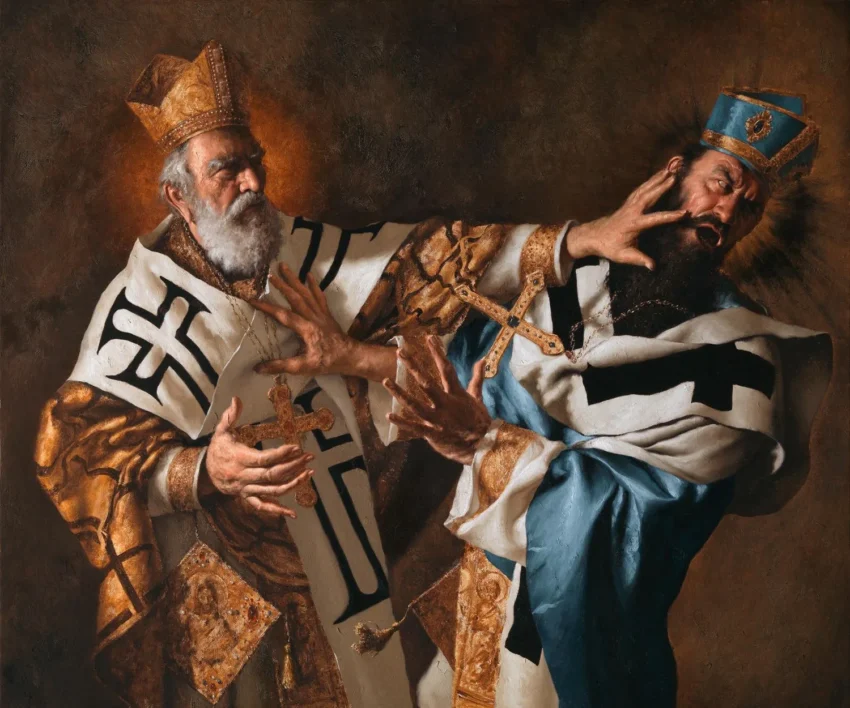
Consider all these theologically opposing camps under the banner of Christianity. As understanding God to be triune is a bone of contention today, so it was during the initial days of this dogma’s development. St. Nicholas, aka Santa Claus, reportedly gave Arius, an alleged heretic, a good slap in the face (see featured image) at the Council of Niceas over this very topic.
The dogma of the Trinity is said to be orthodox Christianity. Yet, we find a large number of Protestants throughout the world who don’t explicitly describe God in that way even though their perspectives aren’t altogether different. They simply make the attempt to use “biblical language” rather than employ the philosophically Greek terms substance (ὁμοούσιος) and person (ὑπόστασις).
Many other Protestants, on the other hand, accept this Hellenistic vocabulary. Others oppose any concept of a three-ness, deeming that altogether heretical.
No different anywhere else
This fragmentation that has always existed is a common feature of any other major religion. Contrary to popular opinion amongst American Evangelicals, there is no monolith of Jewish thought. Over the course of their Babylonian Exile and ensuing diaspora, their return to Jerusalem, and their miraculous Maccabean victory over the Hellenistic Seleucid Empire, the Jews were divided into various theological camps. In fact, even the Hebrew Bible, or Old Testament, demonstrates strong divisions amongst Jews as far as which divine being to worship.
That original Jesus movement was another Jewish group. But it became the group that formed a more powerful, and millennia-long legacy. The others, pagan and Jewish, either faded away or were politically suppressed.
The Judaism of today is a far cry from the Hebrew faith of the Old Testament. Much has changed since the Romans drove the Jews out of Jerusalem in the second century. Orthodox rabbis today see themselves as the spiritual descendants of the Pharisees. The Sadducees and others died out.
Those who claim Judaism today oppose each other theologically. That has me asking: Will some of the descendants of those Jews initiate another belief system, preach it to the nations, and watch the ethnic demographic shift to a Gentile majority once again, perhaps in the — I don’t know — 28th century?
(That was a random century by the way.)
The Muslims have their dysfunction too
We can briefly mention here the Muslims. The Arab world had developed Islam after exposure to various traditions, particularly the Judaism and Christianity of that time and place.
As soon as Mohammed died in 632, his followers split into two major camps — the Sunni and the Shia. The Sunni contended Mohammed didn’t name his successor. The Shia said he did. Thus the split.
And, of course, from those two groups, we have others who identify as Muslim but also claiming other forms, perhaps subgroups of the two, such as Sufi, Ibadi, and Ahmadiyya.
And on and on it goes . . .
The fascinating Mormon phenomenon, a case study
Consider also the Mormons. There we have a radical break from the early church councils that developed the “orthodoxy” (the dogma of the Trinity) we see today. They have a concept called exaltation in which a human may be exalted to a divine being, a god.
Then shall they be gods, because they have no end; therefore shall they be from everlasting to everlasting, because they continue; then shall they be above all, because all things are subject unto them. Then shall they be gods, because they have all power, and the angels are subject unto them. — Doctrine and Covenants (132:20)
If I have descendants a couple millennia later, what will they believe? Maybe they’ll be Mormons living in the New Holy Land — you know, the land that Jesus walked. That would be the Mormon States of America.
Non-Mormons would be driven to live along the American coasts, trapped by the Mormon Border Patrol. Polygamy had long returned already, codified within the new constitution. God told the Mormon apostles to bring it back. That means Mormons need a whole lot of real estate — and a lot of women.
The vast majority of non-Mormons trapped along the coast will be men because there are no women to marry — just like the situation in Kabul where the minority rich steal them all. But more women will be needed. Thus the Mormon invasion of Scandinavian regions. After all, Scandinavian women are in keeping with Mormon tradition.
Why these musings?
Well, they’re fun sometimes . . . I guess.
But in all seriousness, I find these musings difficult to avoid when placing myself in the middle of human chronology rather than close to its end. Two years in that truly Eternal City, gazing at the ruins of a once great Roman Empire greatly impacted me for good or ill. Those ancient Romans must have thought they were the center of the world, the center of history. They left an indelible mark upon us, no doubt. But how indelible will that mark be upon human civilization another two millennia later?
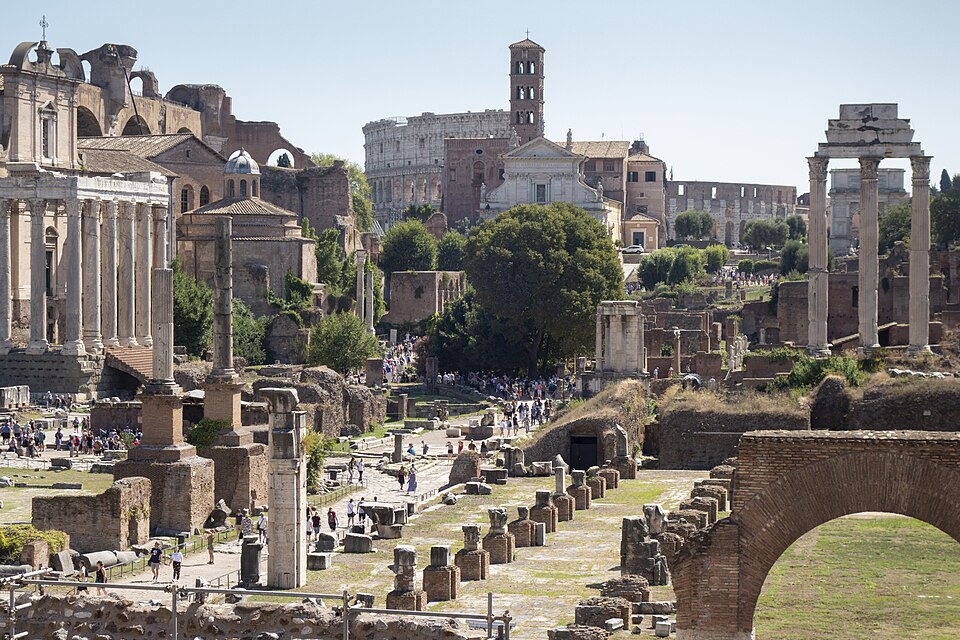
Observing the rubble in the Roman Forum, the center of that once great empire, what would have been our Washington DC, personally gave me a powerful, unforgettable history lesson. It’s rather humbling and quite scary to think of myself as another human who came into this world only to leave it very soon the very same way those ancients of the Roman Empire did, or anyone else thousands of years ago.
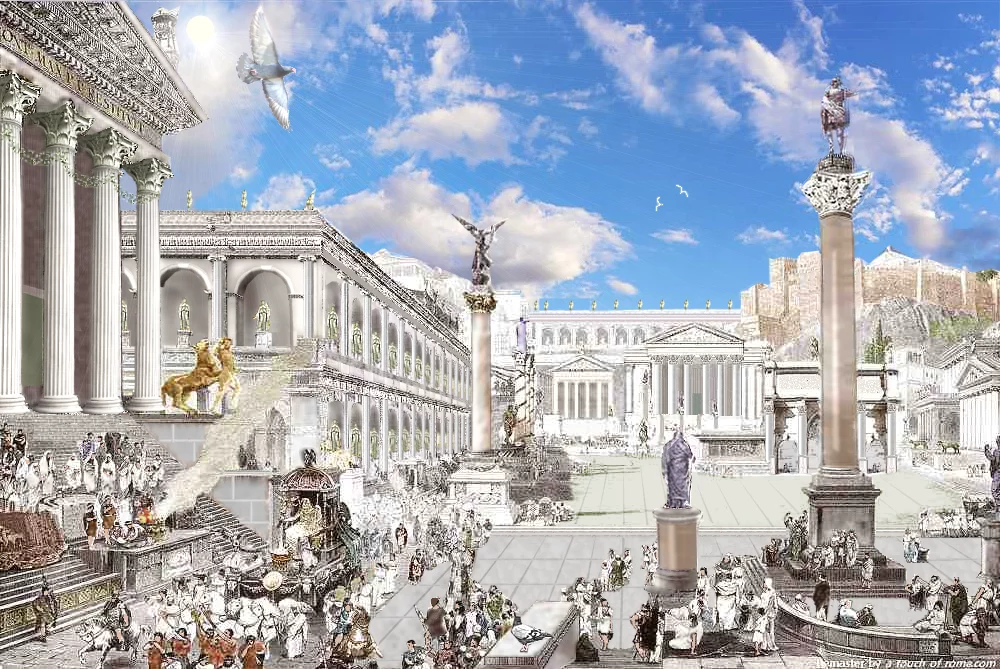
But on the other hand, it stretches my imagination. It gives me great wonder to think about eons of time and this vast physical universe. I know I don’t know much of anything. No one does. And that is something I try to appreciate and accept even though I often fail to do that.